
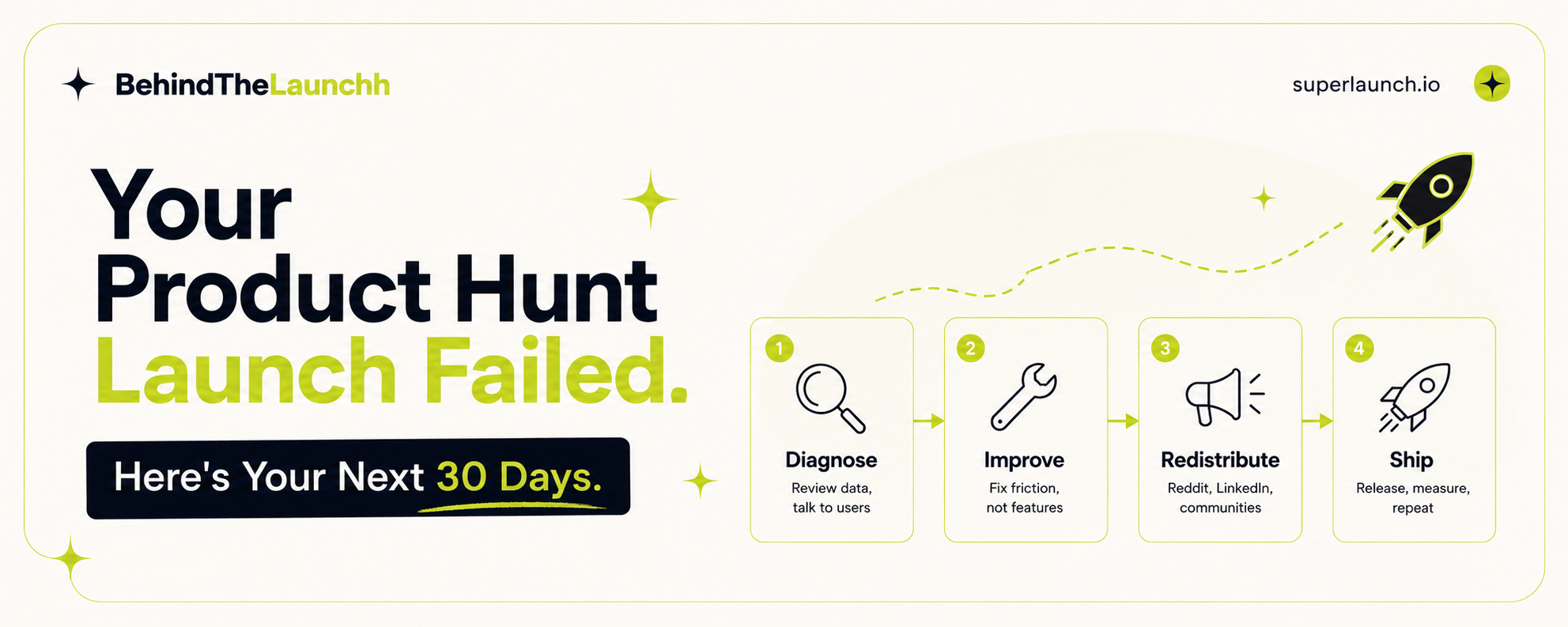
Your Product Hunt Launch Failed. Here's Your Next 30 Days.
What to do in the 30 days after launch day doesn't go the way you hoped.

You spent weeks prepping.
You wrote the tagline twelve different ways. You lined up your first comment. You set an alarm for midnight PST because that’s when the Product Hunt day “starts,” and somehow that detail felt important enough to lose sleep over.
You launched.
You refreshed the page every few minutes for the next six hours. You watched the upvote count. You watched the comment count. You watched your rank.
Twenty-four hours later, it was over.
Maybe you finished #27. Maybe #41. Maybe you got a dozen comments, half of them from people you personally messaged. Maybe the “Maker” badge is the only thing that feels real about the whole day.
Now what?
Almost every Product Hunt guide on the internet stops right here. They’ll tell you how to pick a launch date, how to build a hunter list, how to write a tagline that doesn’t sound like everyone else’s tagline. None of them tell you what to do the morning after, when the traffic has dried up and you’re staring at an analytics dashboard that looks nothing like the screenshots in those guides.
This article starts there.
Your Launch Probably Didn’t Fail
Let’s get one thing out of the way first.
A lot of founders define “failure” as not hitting Top 5. Or not getting featured in the newsletter. Or not crossing some round number of upvotes they’d quietly decided mattered.
None of that is actually a measure of whether your product is good, or whether people want it, or whether you have a business.
Product Hunt measures one thing: how your launch performed on Product Hunt, on that specific day, against whoever else happened to be launching at the same time. That’s it. It’s not a referendum on your startup.
A few things that genuinely affect your rank and have nothing to do with your product:
Timing. Launch the same day as three well-funded, well-networked teams and you’re competing for the same attention, not on equal footing.
Existing network. Founders with large Twitter/X followings or big hunter networks start the day with a head start you don’t have yet.
Audience fit. Product Hunt’s audience is heavy on builders, indie hackers, and tech early adopters. If your product is for accountants or dentists, you launched in front of the wrong room.
Luck. Plain and simple. Some days the algorithm is kind. Some days it isn’t.
None of this is an excuse to ignore real feedback. If people tried your product and bounced, that’s signal worth taking seriously. But the leaderboard position itself? That’s noise dressed up as a verdict.
The founders who build real companies aren’t the ones who nailed launch day. They’re the ones who treated launch day as one data point and kept moving.
Stop Doing These Things
Before we get into what to do, here’s what not to do in the days right after a quiet launch. These are the traps that waste time and momentum.
↳ Assuming nobody wants the product. A flat Product Hunt day tells you about Product Hunt traffic, not market demand. You need more signal before drawing that conclusion.
↳ Bolting on random features immediately. This is the classic panic move. A weak launch doesn’t mean your roadmap is wrong. It means your distribution day was rough.
↳ Changing your pricing overnight. Pricing decisions deserve data, not panic. Give yourself at least a week of real usage before touching it.
↳ Obsessing over the final rank. It’s already final. There’s nothing left to extract from staring at it.
↳ Quietly giving up on marketing. This is the costliest mistake on the list. A bad launch convinces a lot of founders that “marketing doesn’t work for us,” when really one channel, on one day, didn’t work.
↳ Comparing yourself to VC-backed launches. A team with a marketing hire, a PR budget, and 50,000 X followers is not running the same experiment you are. Different inputs, different outputs. Comparing your day-one numbers to theirs isn’t useful information, it’s just a way to feel bad.
Action box: Before you change anything about your product, pricing, or strategy, give yourself 72 hours to actually look at the data. Section 3 tells you exactly what to look at.
Day 1–3: Diagnose
Resist the urge to react. First, understand what actually happened.
Here’s the checklist:
Traffic
Where did visitors come from? Direct Product Hunt traffic vs. social shares vs. people who found you elsewhere that day.
How long did people stay on the page?
Signups
How many people signed up relative to visitors? This is your top-of-funnel conversion rate, and it matters more than your PH rank ever will.
Activation
Of the people who signed up, how many actually did the core action your product is built around?
Retention
Did anyone come back the next day? The next week? Early retention, even from a small number of users, tells you more than a launch-day spike ever will.
Comments
Read every single one. Not for ego. For patterns. Confused comments point at unclear positioning. Skeptical comments point at trust gaps. Genuinely excited comments point at who your real audience is.
Emails and DMs
Anyone reach out personally? Those are often your most motivated early users, and they deserve a real reply, not a template.
User interviews
Pick five people who signed up and ask if they’ll do a 15-minute call. This single step usually produces more useful information than the entire launch day combined.
Product Hunt tells you how many people looked. It doesn’t tell you why they left, or why a few of them stayed. Only you can find that out, and only by asking.
Week One: Improve the Product
With three days of real data, you’ll usually find the same handful of friction points showing up again and again. Fix those. Resist the urge to do anything bigger.
Focus on:
Landing page clarity. If multiple comments asked “wait, what does this actually do?”, that’s your answer. Rewrite the headline before you touch anything else.
Onboarding. Where did signups drop off before activating? That’s your highest-leverage fix this week.
Pricing friction. Not a full pricing overhaul. Just check whether the price was confusing, hidden, or mismatched with what people expected.
Bugs that came up under real traffic. Launch day is the first time most products see meaningful concurrent usage. Fix what broke.
Your call-to-action. Is it obvious what someone should do next on your site? Half of post-launch traffic loss is just unclear next steps.
That’s the whole list. Don’t rebuild your product based on one rough day of feedback. Tighten what you have, then go get more people to look at it.

Week Two: Restart Distribution
This is the part most “how to launch on Product Hunt” guides skip entirely, and it’s the most important week in this whole plan.
Product Hunt was never supposed to be your only distribution channel. It’s one channel, with one specific audience, active for one day. Treating it as your entire go-to-market plan is the actual mistake, not your rank.
Here’s where else to put your energy in week two:
Reddit. Relevant subreddits for your category, plus broader startup communities. Reddit rewards honesty and punishes anything that reads like a pitch. The upside is an audience that already trusts peer recommendations over ads.
LinkedIn. Especially if your buyer is a working professional rather than a hobbyist builder. A founder-written post about what you learned from launch outperforms a polished announcement almost every time, because people engage with people, not press releases.
X (Twitter). Building in public, sharing real numbers, and replying to people in your space all compound here. Every reply is a small chance to be discovered by someone in that person’s audience too.
Founder communities and Discord servers. Indie Hackers, niche Slack and Discord groups, and founder-only communities are full of people who’ll actually try your product and tell you the truth about it. The feedback tends to be more useful than launch-day comments, because there’s no leaderboard incentive distorting it.
Facebook groups. Underrated for certain categories, especially local services, parenting, hobbies, and small business tools, where the audience often isn’t active on X or Reddit at all.
Directories. There are dozens of smaller directories beyond Product Hunt that take submissions year-round, not just on one launch day. Each one is a small, low-effort shot at incremental traffic and a backlink.
Newsletter submissions. Niche newsletters in your category often have far higher intent-to-attention ratios than big platforms, since their readers opted in specifically for that topic.
Show HN. A different audience than Product Hunt, skewed more technical, and worth a separate attempt if your product fits. Treat it as its own launch, not a rerun of your PH post.
Alternative and ongoing launch platforms. Some platforms are built specifically for the weeks after a Product Hunt launch, not just one big day. This is exactly the gap SuperLaunch was built to sit in: a place where your tool stays visible and gets structured feedback from real reviewers over days and weeks, not just one 24-hour spike.
Direct email outreach. Slower, but the highest-intent channel available to you. A short, specific email to someone who fits your ideal user beats a hundred passive impressions.
Each of these contributes a little. None of them will single-handedly replace a Top 5 Product Hunt finish, and that’s fine. The goal isn’t one big spike. It’s several small, repeatable ones that stack.

What we actually tried
We’ve run SuperLaunch through some of this ourselves, so here’s what happened, without the highlight-reel version.
Reddit, with no pitch at all. A few days after our own launch, distribution had stalled. We posted in five to seven relevant subreddits offering free, honest feedback on AI tools and SaaS products from a small community of reviewers. No pitch. No paid angle. Just an offer framed around “real feedback, not cheerleading,” aimed at early-stage founders and vibe coders who were tired of empty encouragement.
One post, late at night, turned into 17+ tool submissions, 18+ comments, and over 900 views within a single hour, along with direct messages from founders asking to join. That post did more for our cold-start problem than launch day itself. After submitting the same post on about 4-5 subreddits, we got 15K+ views from Reddit alone.
What we learned: the offer mattered more than the platform. “Free honest feedback, no strings” is a message Reddit users actually trust, because it doesn’t read like marketing.
Direct outreach instead of waiting to be found. Rather than relying on people discovering us organically, we started reaching out to founders directly, on LinkedIn and in founder communities, the same way we’d want someone to reach out to us. Slower than a viral post, but it’s the channel that’s produced the most consistent, qualified submissions over time.
What we learned: distribution doesn’t have to be passive. Asking directly, one founder at a time, works even when it doesn’t scale the way a Reddit post does.
A small paid test on X, almost by accident. We ran an X Ads experiment with a budget of $6. That’s not a typo. It generated over 85,000 impressions and led to 10-12 product submissions.
What we learned: on a platform where the algorithm is actively looking for content worth amplifying, even a tiny, almost throwaway budget can outperform what you’d expect, if the offer and the targeting are right. We’re not claiming this is repeatable at scale, but it’s proof that you don’t need a real ad budget to find out whether a channel is worth more investment.
Learn from Other Founders
You’re not the first founder whose Product Hunt launch undersold the product. Here’s what happened to a few others, and what they did next.
A few patterns show up across almost every one of these:
↳ Unnamed SaaS founder Called the launch “just a brief moment,” not the real growth driver. Growth actually came from Discord, Reddit, and niche craft forums discovered after launch. No exact numbers shared, but the founder said these later communities mattered more than launch day. Lesson: a quiet launch can still be useful if it pushes you to find where your real users hang out.
↳ Starter Story Got awareness and backlinks from Product Hunt, not much direct traffic. Growth actually came from Reddit and organic SEO. Roughly 2,000 visitors and 100 subscribers from the PH launch itself; real traction came later. Lesson: Product Hunt is often a visibility event first, an acquisition channel second.
↳ EmailEngine Strong credibility and backlinks from launch, minimal direct conversion. Growth actually came from open-source community traffic. Customer acquisition came from open-source channels, not the launch. Lesson: a launch can pay off in trust and SEO long before it pays off in revenue.
↳ NoteForms Traffic, credibility, and backlinks from launch, but zero direct sales. Growth actually came from long-tail SEO and brand visibility over time. Valuable backlinks, no immediate sales. Lesson: search traffic frequently outlasts launch-day hype as a real channel.
↳ ChatPal Strong launch metrics, but the founder credited the real value to the focus the launch forced, not the leaderboard spot. Growth actually came from founder-led content and continued engagement with the launch community on X. About 2,000 site visits, 137 downloads, and 50+ backlinks within 36 hours. Lesson: a good launch is also a forcing function. The content habits it builds can outlast the spike itself.
↳ BaseTemplates Launch started as what the founder called “invisible growth” before becoming a real inflection point. Growth actually came from ongoing brand awareness rather than a single spike. Grew toward $10K+/month over time. Lesson: the launch can be a catalyst. The compounding happens in what you build after it.
↳ Questflow Reported a real SEO boost in the window after launch. Growth actually came from community activation that spilled into organic search. Founders described it as “a serious bump” alongside 5,100+ page views. Lesson: launch attention can convert into durable search visibility when it earns mentions and links.
↳ History Search Used the launch as a path from early idea to first revenue, with content explaining the product alongside it. Growth actually came from content that clearly explained the product and the problem it solved. 1,000 signups in the first two days. Lesson: clear explanatory content keeps working long after the launch-day traffic fades.
A few patterns show up across almost every one of these:
Product Hunt frequently works as an awareness and credibility layer, not the acquisition engine itself.
Reddit, SEO, open source, and founder-led content show up repeatedly as the channels that actually convert.
A quiet launch isn’t a dead end. It’s often the moment a founder finally figures out where their real users are.
Build Long-Term Distribution
The founders who keep growing after a flat launch all share one habit: they’re not relying on a single event to carry their distribution. They’ve built assets that keep working without them refreshing a leaderboard.
The assets worth investing in:
A blog. SEO content compounds. An article you write this month can still be bringing in visitors a year from now, long after a launch-day spike has flatlined.
A newsletter. Owned audience, no algorithm in between you and your reader. Every issue is a guaranteed touchpoint, not a hope that the feed cooperates.
A community. Discord, Slack, or even a simple group chat of your most engaged users. These people become your earliest evangelists and your most honest critics.
SEO. The long, slow channel that almost nobody mentions in launch guides, and almost everyone wishes they’d started earlier. It’s the one channel that keeps working while you sleep.
YouTube. Especially powerful for products that benefit from being seen in action, where a single demo video can keep surfacing in search for years.
An X audience. Built through consistent, specific posting, not just launch-day threads. The accounts that grow are the ones that show up daily, not the ones that post once and disappear.
A LinkedIn audience. Particularly valuable for B2B and professional tools, where buyers are more likely to trust a founder’s post than a company page.
An email list. The one channel you fully own, regardless of what any platform decides to change tomorrow.
A launch is an event. These are assets. Events end. Assets compound.
Your 30-Day Recovery Plan
Here’s a practical, week-by-week roadmap for the month after a launch that didn’t go the way you’d hoped.
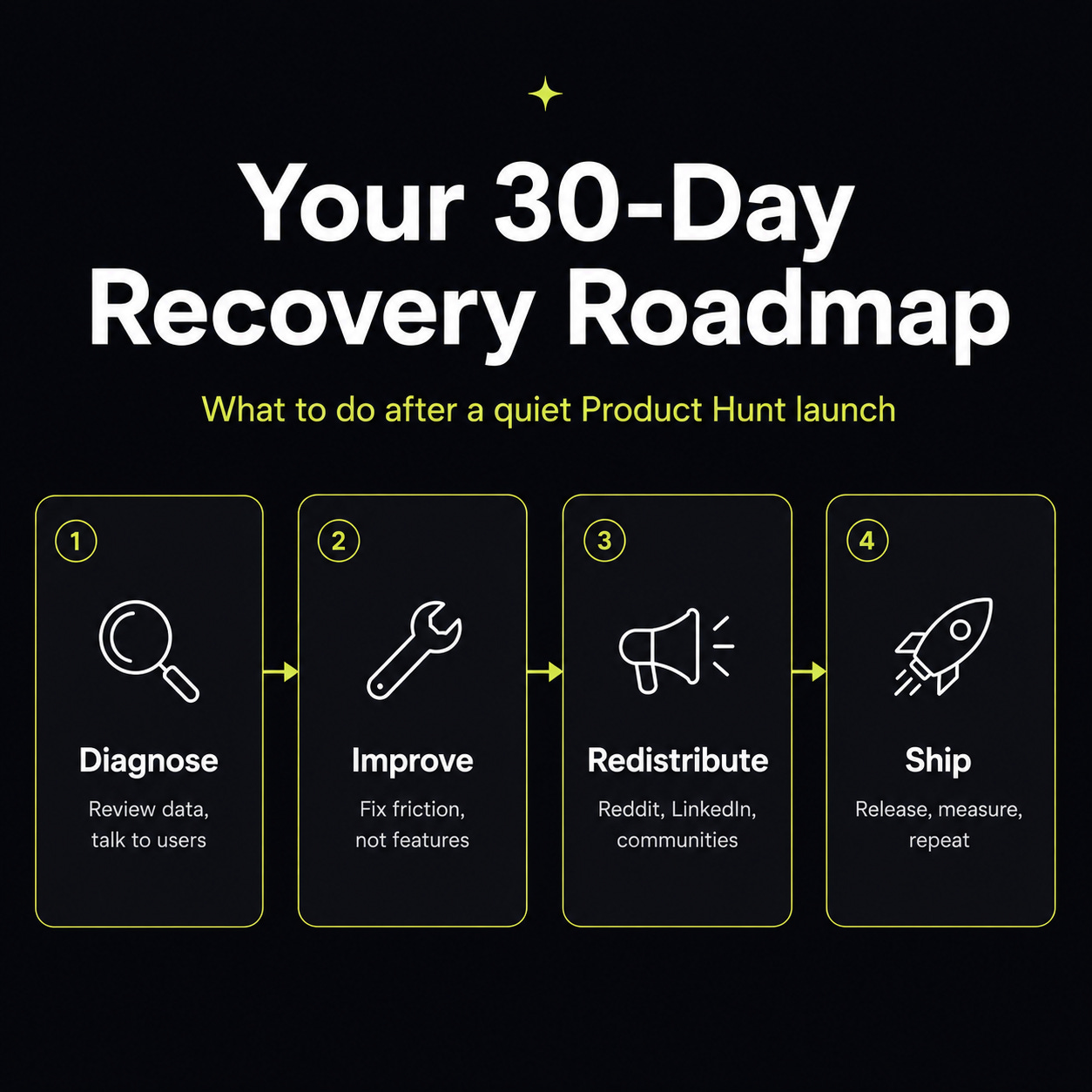
Week 1: Understand what happened Review traffic, signups, activation, retention. Read every comment for patterns. Talk to 5 early users. Fix the highest-friction onboarding step.
Week 2: Restart distribution Publish an honest launch recap. Post in 5-7 relevant Reddit and founder communities. Submit to 2-3 directories beyond Product Hunt. Send 10 direct outreach messages to ideal users.
Week 3: Build proof and content Collect 2-3 testimonials from early users. Publish one piece of content explaining the problem you solve. Reach out personally to 10 more potential users or partners.
Week 4: Ship and measure Release the fixes from Week 1. Tell your existing users what changed and why. Measure traffic, signups, and retention against Week 1’s baseline. Repeat what worked.
Pick one metric from Week 1 (signups, activation rate, or retention) and track it every week through Week 4. If that one number is trending up, your recovery is working, regardless of what your Product Hunt rank says.
Final Thoughts
A Product Hunt launch lasts one day.
Distribution lasts as long as you keep showing up.
The founders who win aren’t the ones who peaked on launch day. They’re the ones who treated launch day as the start of a longer conversation with their market, not the end of one.
If your launch didn’t go how you hoped, you’re not behind. You’re exactly where most successful founders have been at some point. The only real difference between the ones who recover and the ones who don’t is what they do in the 30 days right after.
Now you know what to do with yours.
If you're past your Product Hunt launch and looking for ways to keep momentum going, SuperLaunch is built for exactly this stage.
It's a place where your tool stays visible for days and weeks, not just one, and gets structured feedback from a community of real reviewers who'll actually use it and tell you what they think.
No leaderboard to obsess over, just ongoing distribution and honest feedback while you keep building. Worth a look if you're still figuring out where your next users are coming from.